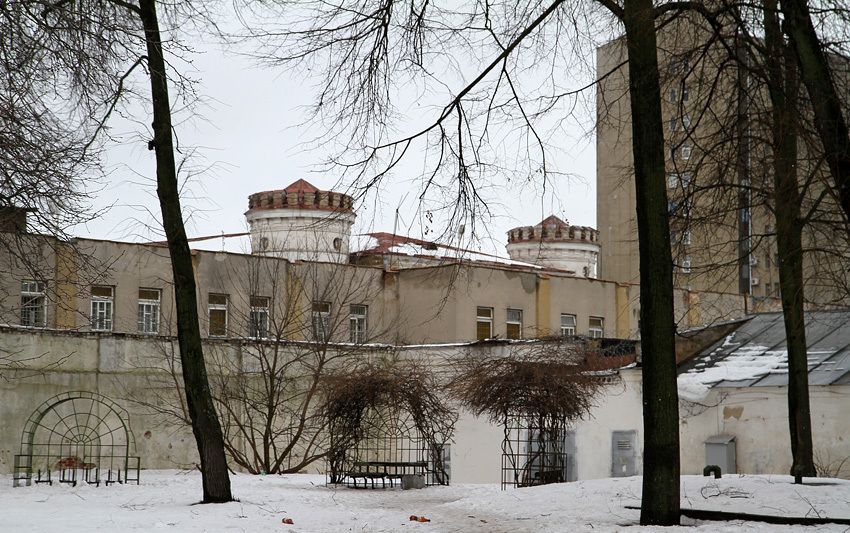
Minsk City Jail — also known as Piščalaŭski Castle, after its architect Rudolf Piszczałło, or simply Valadarka, after Valadarskaha Street — was built to a standard design in 1825. Until recently, it officially housed Remand Center No. 1 of the Department of Corrections under Belarus's Ministry of Internal Affairs. Back then, the new stone fortress was intended to replace the old wooden jail. For almost 200 years, the building has been a symbol of state violence and repression. Behind its walls, participants in the 1863 uprising, Belarusian writers Vintsent Dunin-Martsinkievich and his daughter Kamila, Karus Kahanets, Yakub Kolas, socialist-revolutionaries including the future founder of independent Poland Józef Piłsudski, and the founder of the Soviet penal apparatus Felix Dzerzhinsky served sentences. In the years of independent Belarus, hundreds, even thousands, of political prisoners passed through Valadarka, among them presidential candidates Aliaksandr Kazulin, Andrei Sannikau, Mikalai Statkevich, Viktar Babaryka, and political and civil figures Pavel Seviarynets, Maryia Kalesnikava, Siarhei Tsikhanouski, Maksim Znak, and others.
One of the most notorious executions is connected with Ivan Pulikhau, a member of the Combat Organization of the Socialist-Revolutionary Party. On 14 January 1906, he made an unsuccessful attempt on the life of Minsk governor Pavel Kurlov, by whose orders a peaceful demonstration in Minsk had been shot in 1905. Pulikhau and his accomplice Aliaksandra Izmailovich were arrested and placed in the city prison. A month later they were sentenced to death, but Izmailovich’s sentence was commuted to hard labor in exile. On 26 February 1906, Ivan Pulikhau was hanged — according to different accounts, either on the gates or on the castle tower. His body hung for two days as a warning to the residents of Minsk. A street in Minsk is named after Pulikhau.
In the 1920s, the prison came under the control of the Cheka and later the OGPU and NKVD. From that time, political prisoners were held here constantly: counterrevolutionaries, kulaks, Trotskyists, “spies,” “betrayers of the nation,” and other so-called anti-Soviet elements. Humiliation and torture by the prison guards accompanied imprisonment. No reliable records of shootings within the prison walls in the early 1920s have been found. The Soviets transported many of their political opponents to executions in Kamaroŭski Forest or the Lošycki Ravine.
The darkest hours came during the Great Purge of 1937–38. On the night of 29–30 October 1937, in the prison basements, executioners in NKVD uniforms shot representatives of Belarus’s intellectual elite — several dozen writers, poets, scientists and state figures.
In early 1938, by order of Aleksandr Gepshtein, head of one of the BSSR NKVD departments, with sanction from the BSSR NKVD commissar Boris Berman and permission from Moscow, a separate block was established in the city prison. It housed people sentenced to death who had wide social connections. The overseer was reportedly a man named Alekov. The block held some 270 people, from whom “by beating and torture” authorities extracted “additional testimonies” against other persons. Documents show that only 38 inmates of this block gave evidence implicating 3,489 people. Those who refused to “cooperate” were kept in especially harsh conditions. Those who “confessed” and named others were placed in privileged conditions and received increased rations.
Among the prisoners was, for example, Branislau Tarashkievich, a Belarusian public figure, politician and linguist. After his sentence on 5 January 1938, he was held in the castle for more than ten months. During that time, he was forced to cling to life and to give testimony against other equally innocent people. According to documents, Tarashkievich “informed” on 249 people.
In the end, all inmates of the block were executed. The executions were registered to have happened on 29 November 1938, but the killings actually took place later, in early December. At the end of November, a series of party and government decisions, as well as an NKVD order, effectively ended the Great Purge and prohibited expedited investigations without the involvement of prosecutors. NKVD officers rushed to cover their tracks and destroy their victims, who could have revealed much about the methods of the “advanced armed detachment” of the Communist Party. Documents indicate that in Minsk, Mahilioŭ, Mazyr and Viciebsk some 371 people were shot; the decisions in their cases were later annulled, and the cases were to be returned for reinvestigation. For violating party directives and orders, several Chekists were removed from posts and even shot.
After 17 September 1939, during the so-called “liberation campaign,” thousands of Polish officers and officials fell into Soviet captivity. Initially, they were held in prisons in Western Belarus. Following an order by NKVD commissar Lavrentiy Beria on 21 March 1940, more than 3,000 detainees were transferred to the Minsk prison. Their traces disappear there; they were likely executed. It remains unclear whether the killings took place inside the prison walls or in the surrounding forests near Minsk.
From 1947 to 1953, the death penalty was abolished in the BSSR as in the rest of the USSR, but after Stalin’s death it was reinstated.
Aleh Alkayeu, the head of Remand Center No. 1 from 1996 to 2001 and the author of Execution Squad, recounted that those sentenced to death were held separately in seventeen cells on the half-basement floor of the detention center. Access was forbidden to most of the staff. A dedicated execution squad of 13 people — employees of the Remand Center, a doctor and a representative of the Ministry of Internal Affairs — carried out the sentences. They were obliged to maintain complete secrecy about their work. After the prosecutor announced refusal of a pardon, the condemned were blindfolded, led to an adjacent room, forced to kneel, and the executioner shot them in the back of the head. The entire procedure takes no more than two minutes. Corpses were packed in bags and secretly buried in unknown locations.
Between 1991 and 2015, Amnesty International estimates that around 400 death sentences were carried out in the Remand Center No. 1 in independent Belarus. In 2024, Remand Center No. 1 moved from Piščalaŭski Castle to a new facility outside Minsk. The authorities plan to renovate the old fortress and turn it into a tourist and entertainment site — with a museum, restaurant and concert venue.
A human rights defender and writer, Nobel Peace Prize laureate for 2022, who was a political prisoner and twice an inmate of Valadarka, wrote the text “Life and Death” about the shootings at the Remand Center in Valadarskaha Street. The text became the foreword to the book The Death Penalty in Belarus (Vilnius, 2016).
“It is impossible for those who have never been in prison to understand what it is. It is even more impossible to understand how it is — to be sentenced to death and be waiting for the execution.”The Death Penalty in Belarus
Ales Bialiatski