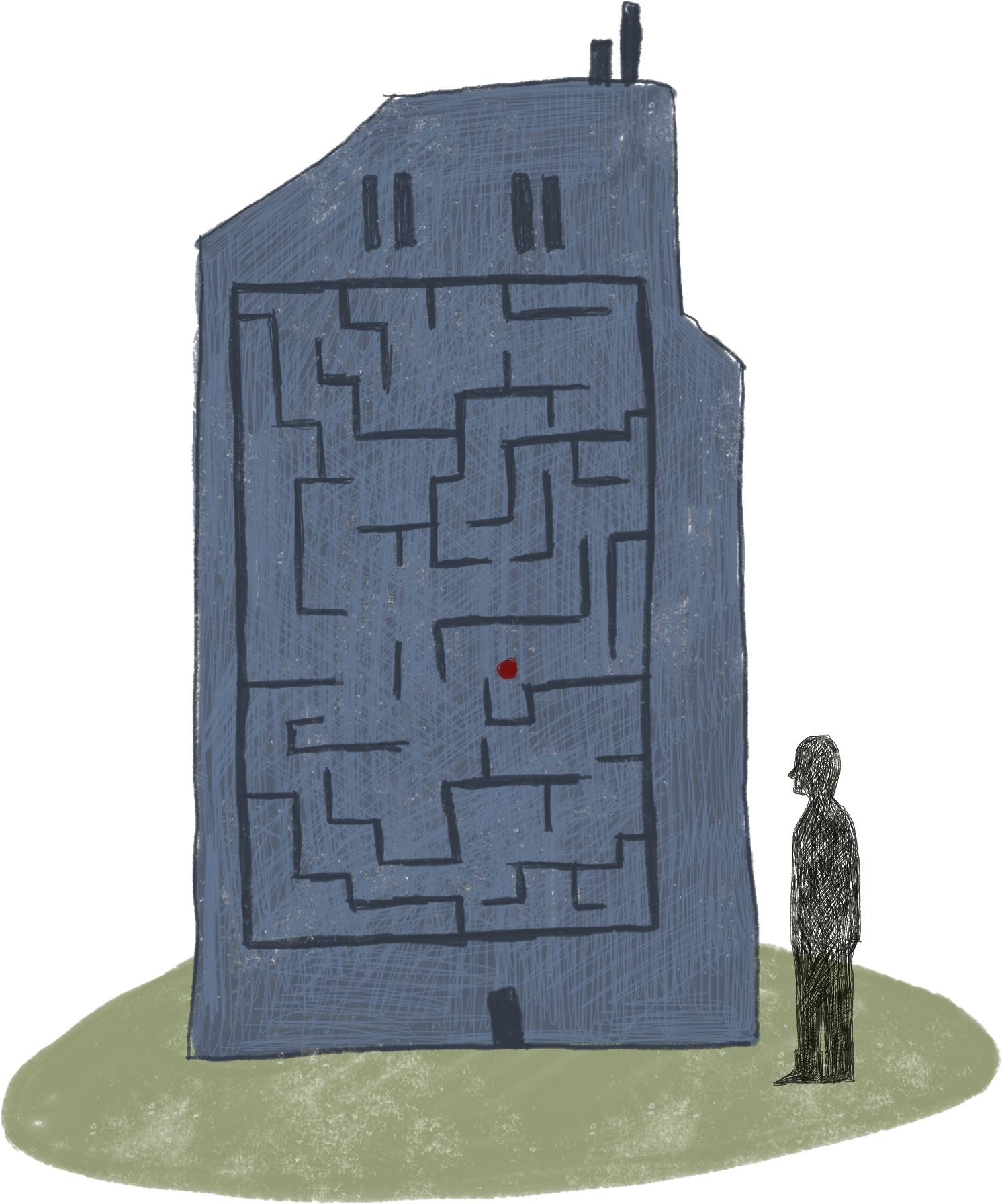
In 1920, the Belarusian Cheka moved into the building constructed in 1915 for the Peasants’ Mutual Agricultural Insurance Society. The building later housed the Joint State Political Directorate (OGPU) and, from 1934, the NKVD (People’s Commissariat for Internal Affairs) of the BSSR; today it is the Ministry of Internal Affairs of Belarus. Interrogations of detainees took place in the investigators’ offices here. Some, unable to endure the abuse, attempted to take their own lives.
For example, on 21 June 1937 at 12:00, Nikolay Goloded, Chairman of the Council of People’s Commissars of the BSSR, who had been arrested and was being interrogated, threw himself from a fifth-floor window of the NKVD building. He died twenty minutes later. For negligence and dereliction of duty by Junior State Security Lieutenant Rulev, an operative officer of the 3rd Department of the State Security Directorate of the NKVD of the BSSR, and Junior State Security Lieutenant Turbin, an assistant operative officer, NKVD Commissar Nikolai Yezhov ordered their arrest and prosecution. He also issued a severe reprimand to Lieutenant of State Security Gepshtein, deputy head of the 3rd Department.
A little later, during the Great Purge of 1937–38, NKVD investigators received direct authorization from Moscow to use unlimited physical measures against suspects. Investigations were conducted at an accelerated pace and according to simplified procedures.
The head of the 3rd department of the National Security Agency under NKVD of the BSSR, Gepshtein, later stated during interrogations after his arrest: “In the second half of October 1937, I returned from Moscow... Berman (the People’s Commissar of Internal Affairs of the BSSR) told me that we had fallen far behind all the Union NKVDs. He said that 2,000 people had been exposed in Leningrad and 4,000 in Ukraine. Therefore, he said, we urgently needed to reorganize our work completely. Berman suggested I convene a meeting of investigators at which he would give instructions...”
To implement the plans set from above, Chekists ran conveyor-belt interrogations, deprived prisoners of sleep for days, and created so-called “suffocation” cells where people were packed like herring in a barrel: they could neither lie down nor sit, only stand pressed tightly against one another. In addition, investigators widely used various devices and methods of torture.
The report of the Central Committee of the CPSU Commission to the Presidium of the same agency on establishing the causes of the mass repression of members and candidate members of the Central Party Committee elected at the 17th Party Congress (9 February 1956) noted that beatings and torture of detainees by the BSSR NKVD during investigations became a widespread phenomenon and the primary method of investigators, reaching sadistic levels in some cases.
It was considered shameful if an investigator did not obtain at least one confession a day. “There was continuous moaning and screaming in the People’s Commissariat that could be heard a block away from the building. The investigative department was especially notable in this regard,” the document read. This practice spread very quickly and widely to all other departments of the Commissariat.
At the same time, the findings of the 1940 commission of the Central Committee of the Communist Party (Bolsheviks) of Belarus, which examined the transfer of cases to the BSSR Prosecutor’s Office, showed that the Prosecutor’s Office exercised no oversight over investigations into counterrevolutionary crimes, detention facilities — particularly internal prisons — or the enforcement of sentences imposed by courts and extrajudicial bodies. Furthermore, during the Great Purge, the BSSR Prosecutor, Samuil Novik, prohibited considering complaints from individuals sentenced to death. Prisoners were often beaten until they lost consciousness. Some did not withstand the sadistic abuses, and prison doctors recorded the death of the suspect.