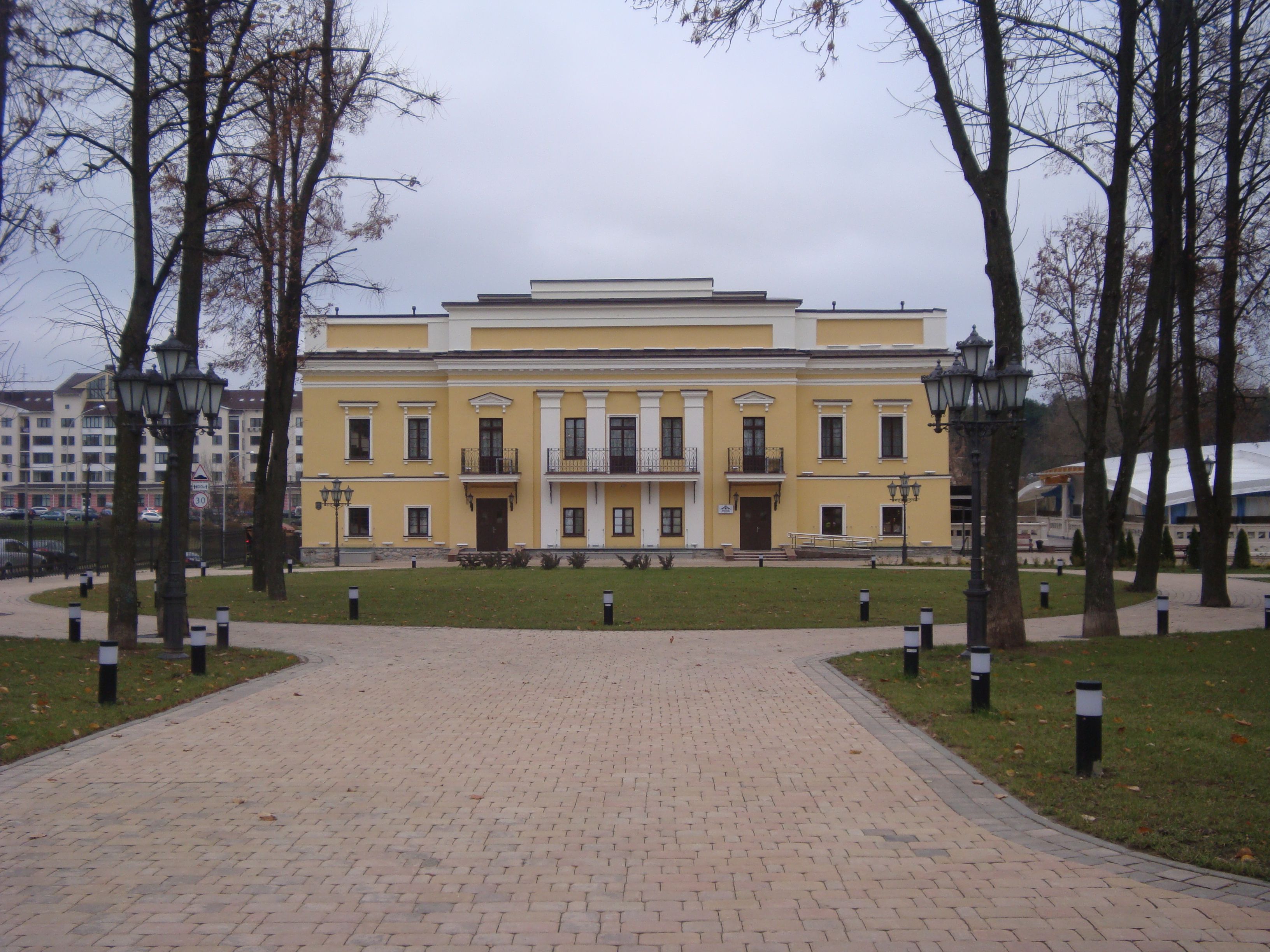
The former Vankovich estate in Sliapianka was nationalized in the 1920s. During the interwar years it housed a state farm office, a potato-breeding station, an NKVD school, and the Minsk Hotbed and Greenhouse Complex. A forest stood nearby.
In 1932, Uladzimir Hutsko, a student at the Minsk Pedagogical Technical School (later known by the pen name Dudzitski), was completing agricultural practice at the estate’s research station. Rumors circulated among students about shootings in the nearby forest. They were even forbidden to leave the barracks, being told that a protected area began nearby. Once, while walking with a companion, Hutsko discovered graves disguised as an animal burial pit. They were located not far from the railway line toward Moscow.
Another student of the Minsk Pedagogical Technical School, the poet Mikhas Kavyl, also recalled shootings and burials in that area: “I remember how we — Siarhei Astreika, Hintaut, Rusakovich — wandered at night through the forest near the Sliapianka State Farm, where we had been sent to achieve the ‘breakthrough,’ and witnessed a shooting. We saw the unfortunate man fall to his knees and raise his hands to the sky. After the shot, he collapsed into the pit.”
In the late 1930s, the dacha of Lavrentiy Tsanava, the new head of the BSSR state security, was built in the forest. On the night of 12–13 January 1948, Solomon Mikhoels, the famous Jewish actor and director who was the head of the Jewish Antifascist Committee, was killed there on Stalin’s orders, along with theater critic Vladimir Golubov. According to Tsanava’s own testimony, at about 10 p.m. the victims were brought to the estate and crushed by a truck. After midnight, their bodies were dumped in the city on a quiet street, staged as a traffic accident. For their participation in the operation, Ministry of State Security officers received high state awards, and Tsanava was awarded the Order of the Red Banner.
After the war, the dacha was used as a kindergarten under the MIA. However, in 2005 it burned down, and six years later it was demolished. In the summer of 2024, during construction of the Utulny residential complex on Parnikovaja Street, builders discovered human bones. The 52nd Special Search Battalion of the Ministry of Defense, in six excavations, found the remains of 75 men and women ranging in age from 18, as well as shell casings and personal items.
Minsk prosecutor Aleh Laurukhin asserted that “there was no information about tragic events in this area.” “We tend to conclude that these people are civilians, since shell casings were found from small arms that were in use by the German army at that time, and the skulls bore entrance and exit holes from gunshot wounds,” the prosecutor said, giving details. He added that archival documents had been thoroughly examined, but none mentioned burial sites near the present-day Parnikovaja Street. “In the testimony of more than 19,700 witnesses interviewed over four years as part of the criminal investigation into the genocide of the Belarusian people, there was also no information about tragic events in this area,” Laurukhin said.
On 17 June 2025, the human remains were ceremonially reburied as victims of the genocide of the Belarusian people at the Čyžoŭskija Cemetery.